
- Article
Why is it worth priming the substrate before welding bituminous felt?
A reliable approach to durable roof waterproofing
A roof that leaks after two seasons? Complaints, lost customer trust – something every roofer wants to avoid. That is why proper substrate preparation, including priming, is not a detail, but the foundation of durable and trouble-free roofing. Although it may seem like a mere ‘formality’, in practice, priming has a huge impact on the durability, safety and effectiveness of the entire waterproofing system.
In this article, we explain briefly and concisely why priming is not an option but a necessity.
Priming is the foundation
The roof substrate – whether it is concrete, sheet metal, OSB or old bituminous felt – is almost always dirty and dusty. Even if it looks ‘clean’, in practice it can significantly weaken the adhesion of bituminous felt. Priming prevents this – bituminous preparations penetrate the substrate, bind dust and dirt particles, stabilise the surface and significantly improve adhesion.
As part of our research and technical validation, we conducted a series of tests on the adhesion of bituminous felts to various types of substrates – both new and renovated. We compared cleaned and uncleaned, primed and unprimed substrates. In all cases, primed substrates achieved significantly better results, with the difference reaching up to 70% higher adhesion compared to unprimed surfaces.
This is not theory, but practice confirmed by validations and experience from real investments.

System warranty – only with priming
More and more bituminous felt manufacturers, including NEXLER, offer so-called system warranties covering the entire product range – from primer, through underlay bituminous felts, to top layer bituminous felts.
One of the key conditions for obtaining a system warranty is proper preparation of the substrate, i.e. priming. Omitting this step often results in the loss of the warranty, which can be very costly in the event of any defects.
For example, the NEXLER system based on the following products:
Penetrator G7 or BITFLEX Primer + PREMIUM PYE PV200 S40 + PREMIUM PYE PV250 S53H comes with a full 22-year system warranty.

Faster work, lower gas consumption
Priming is not only a matter of adhesion – it also saves time.
On a primed surface, heat from the torch is transferred more efficiently to the bituminous felt, as the primer layer evens out and improves the thermal conductivity of the surface. As a result, the bituminous felt reaches the required temperature faster, which reduces the time needed to achieve a proper weld.
In practice, this means that work can be up to 15% faster and gas consumption can be reduced by up to 10%. These differences have been confirmed both in our tests and in actual projects. This effect is particularly noticeable when renovating roofs with old bituminous felt coverings. On large surfaces, this not only means better efficiency, but also measurable cost savings.
What is more, shorter exposure of the bituminous felt to fire during welding translates into a longer service life. Excessive exposure to high temperatures can lead to overheating and accelerated ageing of the bituminous layer. Excessive welding can also weaken the reinforcement, causing it to wrinkle, which in the long term increases the risk of damage and leaks.
A well-primed substrate therefore not only ensures faster welding, but also longer durability of the entire covering.

Additional protection against moisture
A good bituminous primer limits moisture absorption from the substrate and protects the substrate from further moisture penetration before the final waterproofing layer is applied.
This is particularly important when working on cool, damp surfaces, where failure to prime could lead to localised detachment of the covering.
Greater safety when working on OSB
During bituminous felt welding, temperatures can reach several hundred degrees.
Dispersion bituminous primers reduce the flammability of wood-based substrates such as OSB.
A primed surface absorbs heat better and minimises the risk of ignition, which directly translates into safety for the roofing team.
Self-adhesive bituminous felts must not be ignored
Priming is crucial not only in classic welding.
It is also an essential step when using self-adhesive bituminous felts – a well-primed surface guarantees durable adhesion of the adhesive layer to the substrate.
Without a primer, the self-adhesive layer will not ‘catch’ and stick to an uneven, dusty or overly porous substrate. This can cause the edges to come loose, especially at the points of contact with vertical elements or at the edges.
In practice, this means a real risk of leaks and seepage and, consequently, the need for repairs.
Priming is an investment in durability
Priming the substrate before welding bituminous felt is not a detail, but a key element of the entire waterproofing system.It guarantees durability, safety and efficient work. If you want to be sure that your projects will be durable and free from complaints, do not skip priming.
Are you looking for proven primers?
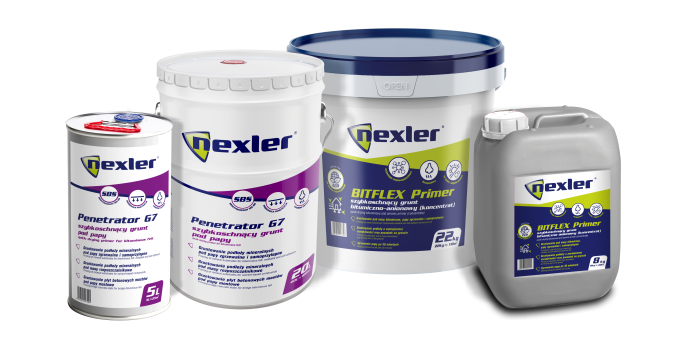
Choose BITFLEX Primer or Penetrator G7 – professional solutions designed for your comfort and effectiveness.
BITFLEX Primer – a solvent-free, odourless bituminous-anionic primer ideal for dry and damp substrates, also in contact with polystyrene.
Penetrator G7 – SBS-modified, with a mild odour and excellent effectiveness even at lower temperatures.
Both products ensure the highest adhesion and full comfort of work, and their effectiveness has been confirmed in hundreds of projects throughout Poland and Europe.
Products used

BITFLEX Primer
Quick-drying bituminous and anionic primer (concentrate)
Find out more
Penetrator G7
Quick-drying primer modified with SBS for under bituminous felt
Find out more