
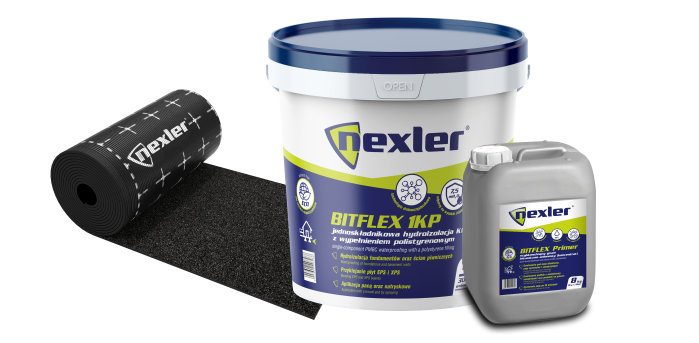
Waterproofing foundations in a single-family home
Foundation waterproofing is a key stage in the construction of a single-family home, which determines the durability and functionality of the building. Improperly executed insulation can lead to moisture, fungus and mould growth, and structural damage.
You can read this article in 5 minutes. You will learn from it:
- What are the types of foundation waterproofing?
- How to choose the right materials?
- How to avoid the most common mistakes when installing insulation?
Types of foundation waterproofing
Foundation insulation is divided according to its location into:
- Horizontal insulation – protection against capillary moisture rising from the ground. Used on strip footings and slabs.
- Vertical insulation – protects foundation walls against ground and rainwater. It must be tight and continuous to effectively protect the building.
To ensure effective protection of the building against moisture, horizontal and vertical insulation should be properly connected, as the basic condition for effective waterproofing is its tightness and continuity.
Choosing the right foundation waterproofing
The choice of waterproofing depends on soil and water conditions and the groundwater level. We distinguish between:
- Damp-proofing – used in permeable soils when the groundwater level is not above the foundations.
- Waterproof insulation – necessary in the case of high groundwater levels or impermeable soils, e.g. clay.
Before starting works on waterproofing the foundations, three questions must be answered:
- Does groundwater constantly or periodically appear near or above the building’s foundations?
- Is there impermeable soil, such as clay, that could cause temporary water stagnation?
- Does the building have a basement?
If the answer to at least one of these questions is YES, it is recommended to use waterproof insulation made of KMB-type compounds. However, if the answers to all of the above questions are NO, the use of thin-fibre compounds may be considered.
What materials should be used for waterproofing foundations?
The use of thin-foil compounds carries a significant risk of compromising the continuity of the coating, which is essential for the effectiveness and durability of the waterproofing. A thin coating can be damaged by groundwater pressure or the accumulation of rainwater. However, it should be remembered that applying too thick a layer of this type of product can lead to cracks.
The decision to use thin-layer insulation involves a risk resulting from the possibility of changes in the water and soil conditions on the plot. These may be affected by urban changes, such as the construction of new buildings in the neighbourhood or the reduction of green areas, which act as natural retention facilities. Climate change can also be dangerous for damp-proof insulation, causing, among other things, prolonged and intense rainfall leading to local flooding or waterlogging.
The answer to these threats is thick-layer KMB-type bituminous compounds which guarantee tightness even in changing conditions. They do not contain harmful solvents, which makes them safe for the environment and allows for subsequent insulation of the foundations. Products available on the market differ in terms of the technologies used. Those based on small-particle technology are particularly valued, as they guarantee better adhesion and sealing, which effectively prevents water from penetrating into the building. In addition, their ease of application significantly affects the quality and durability of the insulation. It is also worth ensuring that the selected product offers protection against radon, as excessive or prolonged exposure to radon is harmful to health. Importantly, thick-layer KMB compounds also allow for the formation of facets, i.e. elements connecting vertical and horizontal waterproofing.
For horizontal waterproofing of foundation footings, with safety and durability in mind, we recommend choosing foundation bituminous felts that are cut to the size of the foundation (20, 33 or 50 cm). It is a safer alternative to foil. Bituminous felts are more resistant to mechanical damage and vulcanise under pressure, which guarantees tightness at the overlaps. As foundation bituminous felts are not sensitive to wind gusts and their width can be adjusted to a specific project, their installation is not a problem.
Preparing the substrate for waterproofing
Before applying the waterproofing coating, it is necessary to thoroughly prepare the substrate. The surface should be clean, free of any loose parts, dust and other contaminants that could adversely affect adhesion. Any defects in the substrate should be levelled and filled.
After thoroughly cleaning the substrate, it is necessary to prime it. When choosing bituminous waterproofing compounds, it is also necessary to use a bituminous water-based primer. We recommend the use of deep-penetrating and quick-drying primers based on advanced fine-particle technology.
Key recommendations for foundation waterproofing
To ensure long-term protection and functionality of the building, the following rules should be observed:
- Maintain continuity of insulation – avoid gaps and thoroughly seal installation penetrations and passages.
- Adequate layer thickness – use the manufacturer’s recommended values to avoid cracks.
- Plinth waterproofing – vertical insulation should extend at least 30-50 cm above ground level.
- Use of protective layers – protect the insulation from damage during construction works.
It is worth remembering that the costs of waterproofing account for approximately 2-3% of the total construction costs in the shell phase, while any repairs can reach up to nearly 20% of the estimated construction costs.
The most common mistakes in foundation waterproofing
When waterproofing foundations, we often encounter mistakes that can significantly reduce its effectiveness. The most common ones include:
- Incorrect substrate preparation – poor adhesion of the insulation.
- Ignoring the manufacturer’s guidelines – improper application and low effectiveness of the insulation.
- Poor choice of waterproofing – failure to take into account the groundwater level.
- Application in poor weather conditions – rainfall can weaken the insulation layer.
Foundation waterproofing is a key element of house construction, protecting against moisture and groundwater. Do you have any further questions? Please contact our Technical Department.
Products used

BITFLEX 1K
Thick-layer waterproofing compound (PMBC) modified with polymers
Find out more
BITFLEX 2KP
Two component thick-layer waterproofing compound (PMBC) modified with polymers with a polystyrene filling
Find out more
BITFLEX 1KP
Thick-layer waterproofing compound (PMBC ) modified with polymers with a polystyrene filling
Find out more
BITFLEX 2K
Two-component thick-layer waterproofing compound (PMBC) modified with polymers
Find out more
BITFLEX Primer
Quick-drying bituminous and anionic primer (concentrate)
Find out more
Fundament
Bituminous felt for horizontal insulation
Find out moreOther articles from the Foundation waterproofing category that may interest you
 Article
NEXLER BITFLEX System for Foundation Waterproofing
Foundations are the cornerstone of any building, channelling its weight to the ground and ensuring structural integrity. For building longevity, robust protection against moisture and groundwater is absolutely essential.